
As PC hardware becomes more capable, many users see their GPUs delivering extremely high frame rates, even on demanding titles. This leads to a common question among gamers and system builders: can a 1080p monitor bottleneck your PC?
Because resolution and refresh rate determine what your display can show, understanding whether a monitor can bottleneck performance is essential when upgrading your graphics card or optimizing overall system balance. While most people talk about CPU or GPU bottlenecks, your monitor can influence how your hardware performs and what you visually experience.
This guide explains when a 1080p monitor can limit performance, how resolution affects GPU load, whether a display can cap FPS, and how to determine if your setup is balanced.
Can a 1080p Monitor Bottleneck?
A 1080p monitor does not bottleneck your PC in the traditional sense, because it does not limit your CPU or GPU’s processing power. However, it does limit what you can see, including resolution and maximum displayed FPS.
A bottleneck occurs when one component prevents another from achieving full performance. A monitor cannot restrict a GPU from producing high frame rates, but a 1080p display can prevent you from experiencing higher visual detail or resolution, and it can make a high-end GPU appear underutilized.
For example:
A GPU capable of producing 250 FPS at 1440p may produce 400+ FPS at 1080p, causing GPU usage to drop significantly. The system is not bottlenecked, but you are not using the GPU’s potential to its fullest.
This is why many consider 1080p a “soft bottleneck” for powerful GPUs, especially in modern titles.
How Resolution Impacts GPU Workload
1080p is the least demanding mainstream resolution. The lower the resolution, the fewer pixels the GPU must render, resulting in lower utilization.
Pixel Count Comparison
- 1080p: 2.07 million pixels
- 1440p: 3.68 million pixels
- 4K: 8.29 million pixels
Because 1080p is easy to render, high-end GPUs often run below their maximum capacity at this resolution. This is not a performance bottleneck; it’s simply a result of lower rendering demand.
Does 1080p Limit GPU Performance?
It limits visible output, not the GPU’s rendering ability.
A GPU rendering 300 FPS on a 1080p monitor still produces all 300 frames, but the monitor may only display a portion of them.
FPS Example
- GPU output: 300 FPS
- Monitor: 1080p 144Hz
- Displayed frames: 144 FPS
The GPU is not restricted; the display simply cannot show more frames than its refresh rate.
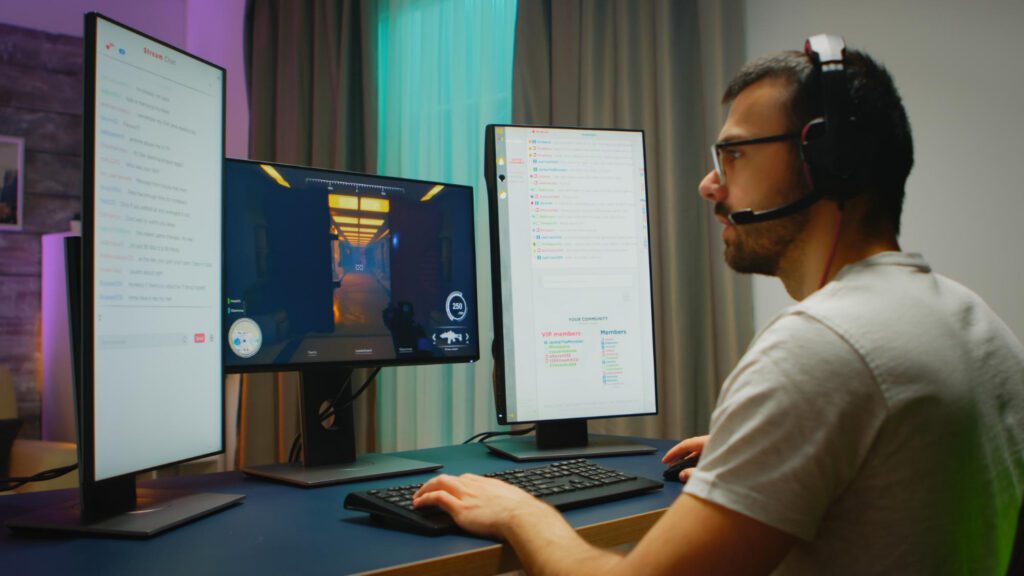
Does 1080p Limit FPS?
No. FPS is limited by the monitor’s refresh rate, not by resolution alone.
A 1080p monitor can display only as many frames as its refresh rate allows:
- 1080p 60Hz → 60 FPS
- 1080p 120Hz → 120 FPS
- 1080p 144Hz → 144 FPS
- 1080p 240Hz → 240 FPS
- 1080p 360Hz → 360 FPS
A GPU may produce much higher FPS, but the monitor will only display frames equal to its refresh rate.
If FPS exceeds refresh rate, the monitor cannot show the extra frames, but the GPU still renders them.
When Can a 1080p Monitor Act Like a Bottleneck?
While not a traditional bottleneck, certain limitations appear when using 1080p with modern hardware.
1. High-End GPUs Become Underutilized at 1080p
GPUs such as the RTX 4070, 4080, 4090 or RX 7900 XTX barely reach full load at 1080p. The GPU isn’t bottlenecked; the resolution is too light.
2. You Lose Visual Quality
A 1080p monitor cannot display the sharpness or clarity of 1440p or 4K, even if your GPU is capable.
3. Refresh Rate Caps What You See
A high FPS output from the GPU will not be visible on a low refresh rate display.
4. CPU Bottlenecks Are More Common at 1080p
At 1080p, games rely more on the CPU because GPU demand is low. This makes CPU limitations more noticeable.
To better understand this, users often consult the How Do I Know If I’m Bottlenecking My GPU? article on system diagnostics.
5. Limited Use of Powerful GPUs
A top-tier GPU may be excessive for 1080p gaming, especially if the monitor has a refresh rate below 144Hz.
Does a 1080p Monitor Limit GPU Output in Gaming?
Visually, yes. Hardware-wise, no.
A GPU can render hundreds of frames per second, but you only see the frames that match your monitor’s refresh rate.
If you use adaptive sync technologies such as FreeSync or G-Sync, your monitor synchronizes its refresh rate with your FPS to reduce tearing and stutter. However, this does not increase the maximum displayed frames.
Should You Upgrade From 1080p?
It depends on your GPU, gaming preferences, and target FPS.
You may want to upgrade if:
1. Your GPU is overpowered for 1080p
Excessive FPS beyond your monitor’s refresh rate offers diminishing returns.
2. You want sharper visuals
1440p and 4K significantly improve image clarity over 1080p.
3. You play competitive titles and want maximum smoothness
A high-refresh-rate 1080p monitor (240Hz or 360Hz) remains a top choice for esports players.
4. You want to use your GPU more effectively
Higher resolutions increase GPU load and reduce CPU bottlenecking.
For users analyzing their system balance, the Bottleneck Calculator helps determine whether their GPU and CPU pairing is optimized.
FAQ: People Also Ask
Does a 1080p monitor bottleneck a GPU?
No. A 1080p monitor does not bottleneck your GPU, but it may prevent you from seeing the full visual capabilities of high-end hardware.
Does 1080p limit FPS?
Only to the extent of your monitor’s refresh rate. Your GPU may produce higher FPS, but the display shows only what it can refresh.
Will a high-end GPU be underutilized at 1080p?
Yes. Modern GPUs are often too powerful for 1080p and operate below maximum load.
Is 1080p still good for gaming?
Yes. It remains the most common resolution and is ideal for high-FPS esports gaming, especially with 240Hz or 360Hz monitors.
Can a monitor cause a bottleneck?
Not in processing power, but it can limit displayed resolution and maximum visible FPS.
For more details, see Can a Monitor Bottleneck a PC?.
Conclusion
A 1080p monitor does not bottleneck your PC in the strict sense, but it does restrict the visual output and can make high-end GPUs appear underused. While your hardware continues performing at full capacity, your display determines what you see.Users who want to know whether their specific setup is balanced can use the Bottleneck Calculator to evaluate CPU and GPU compatibility.